President Obama Bestows National Medal of Science on SLAC Director Emeritus and Nobelist Burton Richter
Burton Richter, Nobel laureate and director emeritus of SLAC, has received the National Medal of Science – the nation's highest honor for achievement in the field of science.
President Barack Obama presented SLAC director emeritus and Nobel Prize winner Burton Richter with the National Medal of Science at a Nov. 20 ceremony at the White House. Richter was one of 10 distinguished researchers presented with the National Medal of Science, the highest honor for achievement and leadership in advancing the field of science.
"I want to congratulate these extraordinary men and women for their accomplishments," President Obama said at the ceremony. "I want to thank each of you for the contributions that you have made to our country and the world, your passion, your persistence, your intrinsic hopefulness."
The citation on Richter's Medal of Science recognizes him "for pioneering contributions to the development of electron accelerators, including circular and linear colliders, synchrotron light sources, and for discoveries in elementary particles physics and contributions to energy policy," according to a White House press release.
“It was a very impressive ceremony and the President made a moving speech,” said Richter, who learned in October that he would receive the award. He attended the ceremony with his wife, Laurose, daughter Elizabeth and son Matthew; SLAC Director Chi-Chang Kao also attended.
“There were a lot of people at the ceremony I hadn’t seen in a long time,” Richter added. "I had known some of the laureates for many years, and it was nice to see them again.”
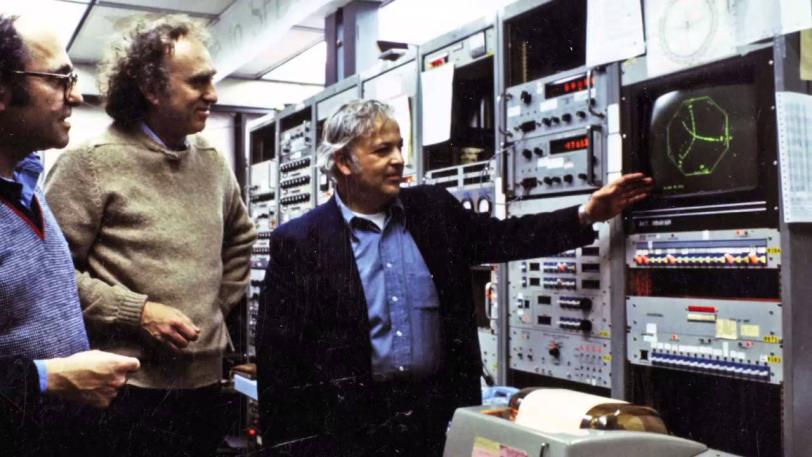
Burton Richter - 2012 National Medal of Science
Contact
For questions or comments, contact the SLAC Office of Communications at communications@slac.stanford.edu.
SLAC is a multi-program laboratory exploring frontier questions in photon science, astrophysics, particle physics and accelerator research. Located in Menlo Park, Calif., SLAC is operated by Stanford University for the U.S. Department of Energy's Office of Science.
SLAC National Accelerator Laboratory is supported by the Office of Science of the U.S. Department of Energy. The Office of Science is the single largest supporter of basic research in the physical sciences in the United States, and is working to address some of the most pressing challenges of our time. For more information, please visit science.energy.gov.
Related stories

Containing multitudes: SLAC scientist collaborates to create scalable qubits